Luce deLire: We are Open - On Hospitality and Contractuality
In ‘Trouble!’ guest artists are invited to show up, or comment — in object form or a performance— on their (fictionalised) private life and how
it informs their financial realities, their economies, and to a larger extent, their politics.” (Beer 2023) This sentence from the project description of
the current exhibition at Cittipunkt Berlin e.V . (of which this text is a component) alludes to two apparently very different social practices: On the one
hand, artists are invited as guests, indicating that the show operates as a sphere of hospitality. On the other hand, guest artists are asked to engage with
their “financial realities, their economies, and to a larger extent, their politics” (ibid.), all of which are usually ruled by contracts. While the contract
seems to indicate a rule that’s set, hospitality seems to allow for degrees of agency, choice even (one may refuse the invitation, possibly, or follow in custom
made ways).
What though is the relationship between a social contract and hospitality, really? One might think that if you scratch hospitality, you will find a contract -
a set of rules and agreements regarding behavior and decency. I want to argue the opposite case: contractuality is hospitality in disguise.
Social contracts usually rest on the exchange of freedom for protection: I submit to your rules, and in exchange you are nice to me. Or, on a bigger scale:
We submit to laws and in turn the laws protect us (ideologically speaking – notwithstanding that oftentimes they really don’t). In this case, Lea submits to the
script her client set up for her (the rules of the encounter), while receiving protection in the form of money in return (protection from poverty and social dependency
in another context that they make us call ‘real life’). Hospitality doesn’t work like this. I suggest to understand "hospitality" as an experience of the political
sublime. Sublimity is commonly understood as an aesthetic category, an experience of infinity: While looking at a landscape from high up or watching a storm through a
window from a cosy bedside, we have a sense of unlimitedness - the infinity of rain drops, of force of nature, or of infinite continuation of the landscape. Suspension
of urgency (being subject to potential dangers etc.) enables a particular aesthetic experience. By way of being removed from the action ever so slightly (overseeing the
landscape, protection from the storm), we are enabled to contemplate or exist in the face of infinity. This contemplation or existence-in-the-face-of is called ‘the sublime’
Where does such infinity come from? It comes from indeterminacy. If you understand what a circle is, that doesn't tell you how many right angles fit into the circle,
and neither does it tell you how many circles exist in the world. Thus, infinitely many rectangles fit into a circle. And infinitely many circles fit into the world (note
that this does not imply that everything had to be covered in circles – for example, some may not be actualized). From indeterminacy, infinitely many things follow.
Now, hospitality is an experience of socio-political indeterminacy. If I invite you over for tea, it is indetermined how many cups you ought to drink, how much time we
ought to spend together etc. Surely, sometimes it is understood that two cups are enough. But at other times, time fades away and we spend hours together, days, weeks, our
lives merge, we transform – with unclear end, or sometimes without an end at all. I want to suggest that this experience of indeterminacy, from which infinitely many things may
follow, is an experience of genuine hospitality. Imagine a dinner party where someone suddenly exclaims: "it's midnight already!" The forgetting of time indicates that the time
shared, however long it may be, feels like a fraction of what would be possible or desired. "It's midnight already!" is thus an expression of infinity, an encounter with the
indeterminacy of social relations that could go on and on (and on and on…) - exactly in the moment of its termination (of course, there are cases where the exclamation is a front
for an early departure instead). It is a tombstone on the experience of such infinity (articulated when the experience is no more). Thus, the sublime is an experience of infinity.
And hospitality is an experience of social infinity. Therefore, hospitality is an experience of the sublime - it is an aesthetic experience (it feels good, feels exciting) with
immediate political consequences, namely forming social bonds that tend to echo into the future and enable trust, sympathy, solidarity etc.
There is, however, another political consequence of hospitality: the unlearning of property. Usually, property, within the ideology of neoliberal capitalism, knows a clear owner
– this is my text, but your interpretation, it’s written on my computer etc. However, genuine hospitality requires us to delve into the indeterminacy of
property: How many cups of tea will we have together? In genuine hospitality, that number is indeterminate, it is in principle infinite. In this way, genuine hospitality is an
experience of a political sublime: a shared infinity or an infinity of sharing. And this is what distinguishes hospitality from contractuality: where the latter
knows only yours/mine, inclusion/exclusion, inside/outside, private/public, the former knows infinitely many finely grained and stratified shades of gray that reside outside, in
between, or in spite of these binary distinctions. Mi casa es su casa. Hospitality allows to live inside the problem of ownership because here, who owns what, who
is who, is indeterminate. It stages this problem (who owns what?) instead of solving it into binary oppositions such as yours/mine, here/there, inside/outside etc. This indeterminacy
enables an infinity to take the place of the binary. And insofar as this infinity concerns the organizing principle of Western societies – property – it is inherently political.
In hospitality, we encounter the glimpse of a social order beyond the paradigm of property, which usually determines how we relate to each other (my stuff/your stuff, my partner/my
friends/my parents/my identity/my debt which enables or prevents my participation in social activities etc.).
Physical intimacy is one of the most delicate and most widespread kinds of hospitality: hospitality to other bodies. Instead of sharing tea, shelter, or passports, physical intimacy
– be it sex or cuddling or otherwise – means to share your very own body with others, that is to say, you are sharing yourself. Intimacy is an extreme kind of hospitality, where the
host is not sharing some external thing, but is sharing themselves instead. Intimacy is embodied hospitality. A host may, for example, let someone (or something)into
themselves. Surely, all hospitality may turn into hostility. But for the moment, I want to dwell on that hospitable sexuality and call it vanilla – not as in ‘ordinary
sex’ and not as opposed to BDSM either. What it is opposed to is solely hostility, understood as the determining force of definitive appropriation – mine mine mine. However,
such vanilla hospitality is the condition of each and any intimate encounter. For every contract, be it a social contract or mere economic exchange, relies on some version of sharing
oneself, opening oneself up to an alien presence, to something yet unknown. Even in its most formalized version, an originary hospitality enables contractuality itself.
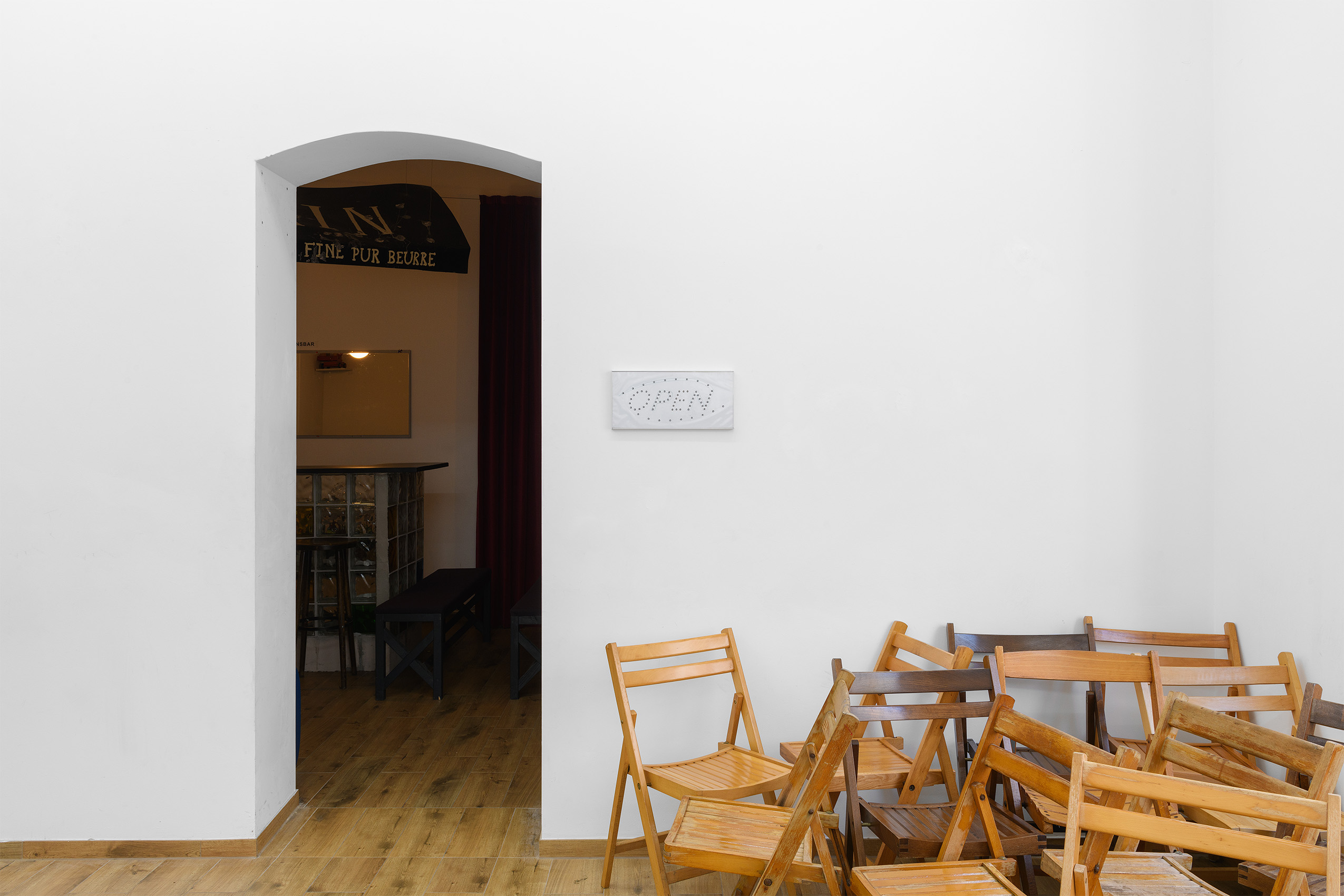
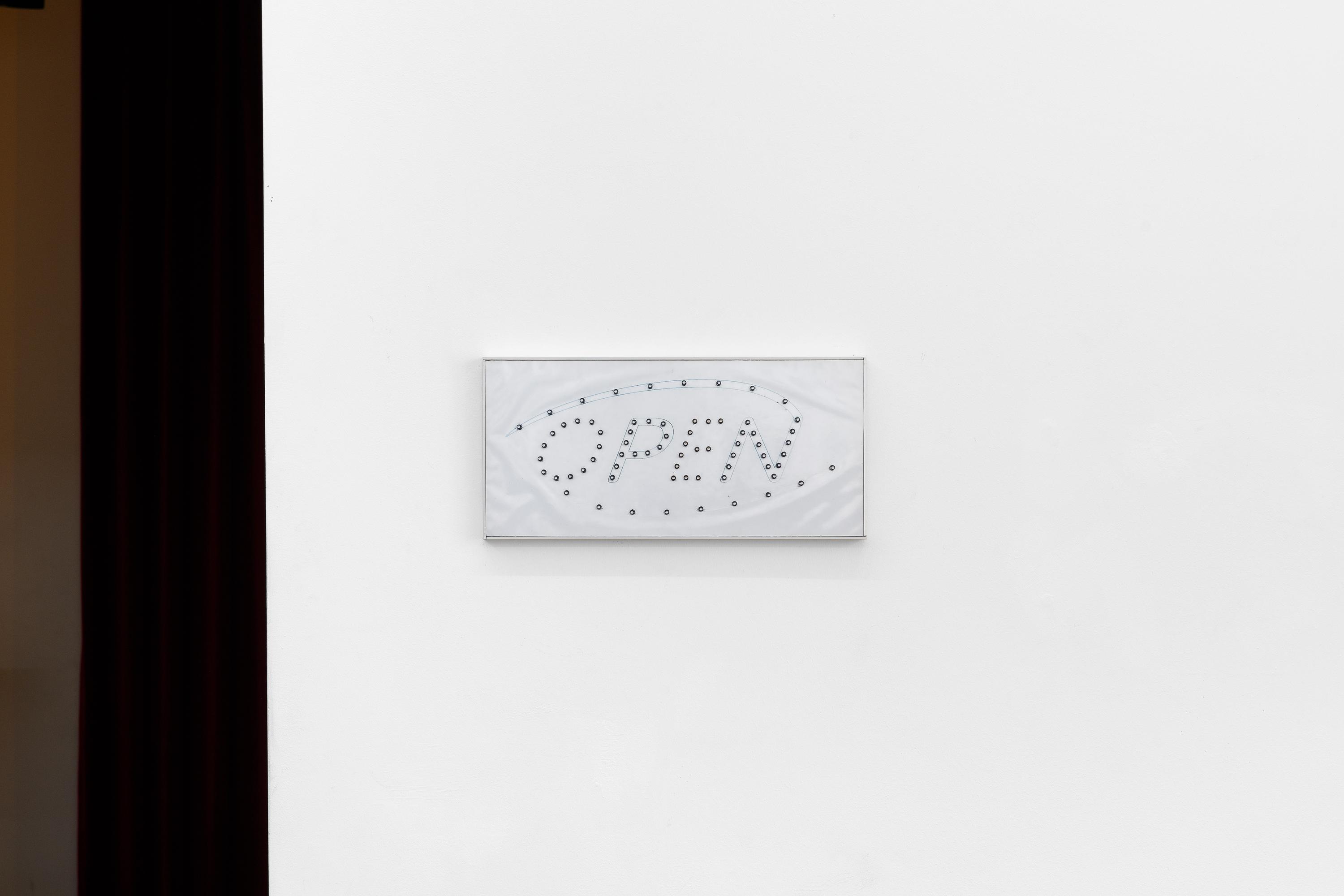
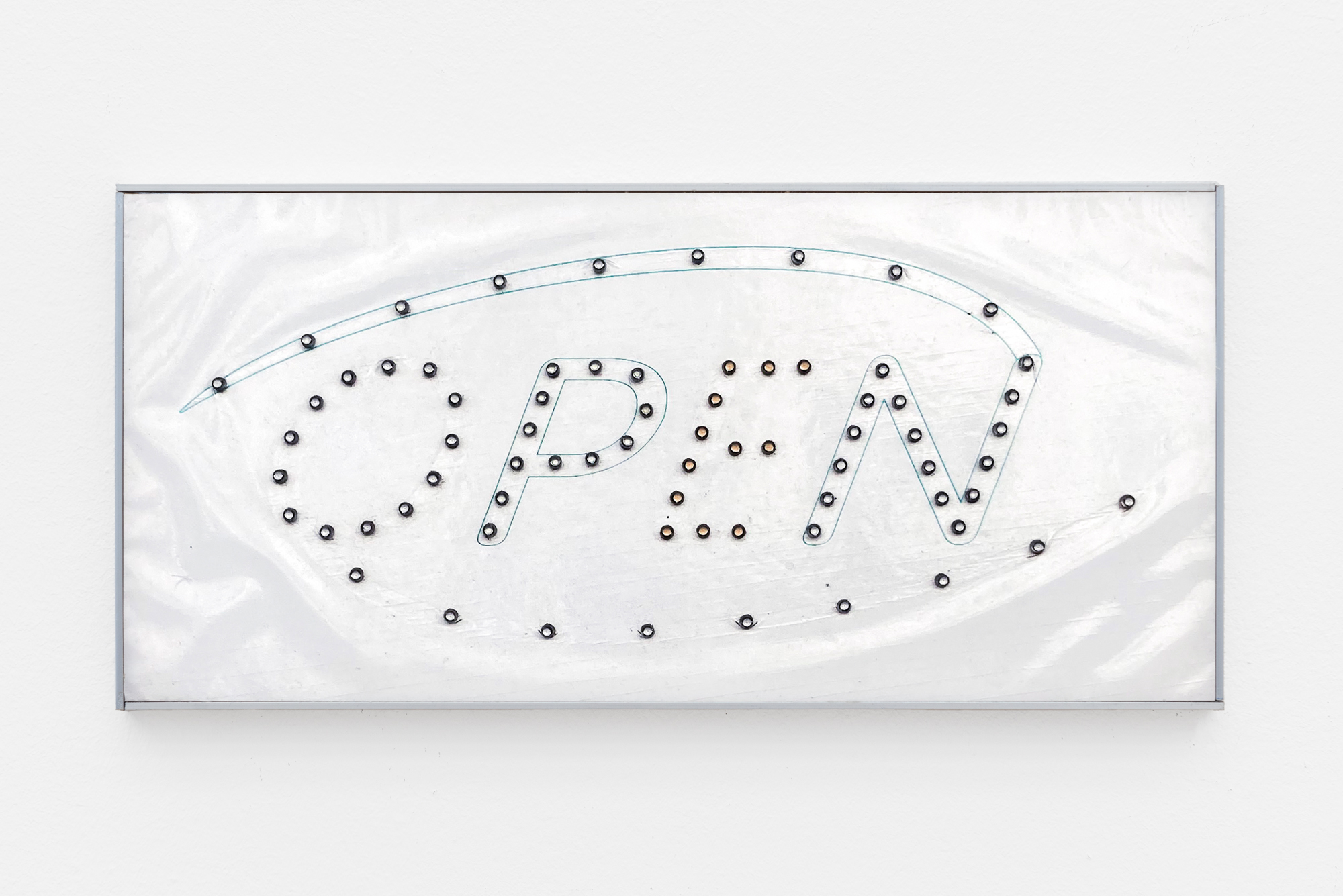
Aisha Altenhofen’s photographic work Conditioned Air (2022) manifests this interplay between contractuality and hospitality: The stylized sign, reminding of brands such as
Nike , says “OPEN” and thus alludes to signs in restaurants and hotels, where hospitality has become a business, hospitality contractualized. The space that spells
“OPEN” reminds of an eye, once because of the swung lines that lead into the word (the first stroke of the N) and out of the word (the dots that taper of the O), and once because
this eye-like shape is mirrored in the surface that underlies the whole word, juxtaposed with an area around it that gives an almost wrinkled look. It is as though an open eye was
providing the space for the word “OPEN”, serving an invitation (but also, open eyes are vulnerable to touch). Both eye and “OPEN” can close, are sometimes not available (and
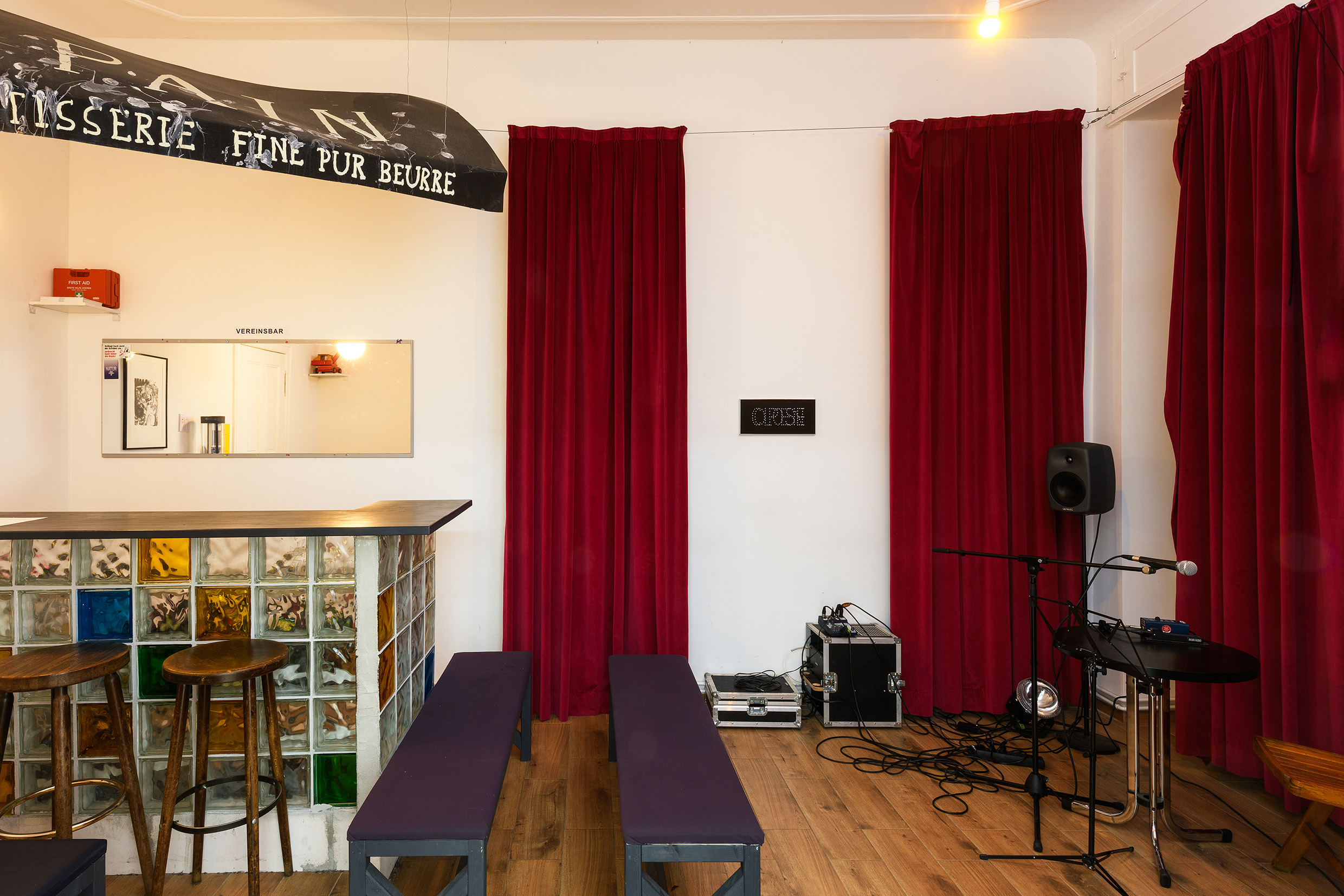
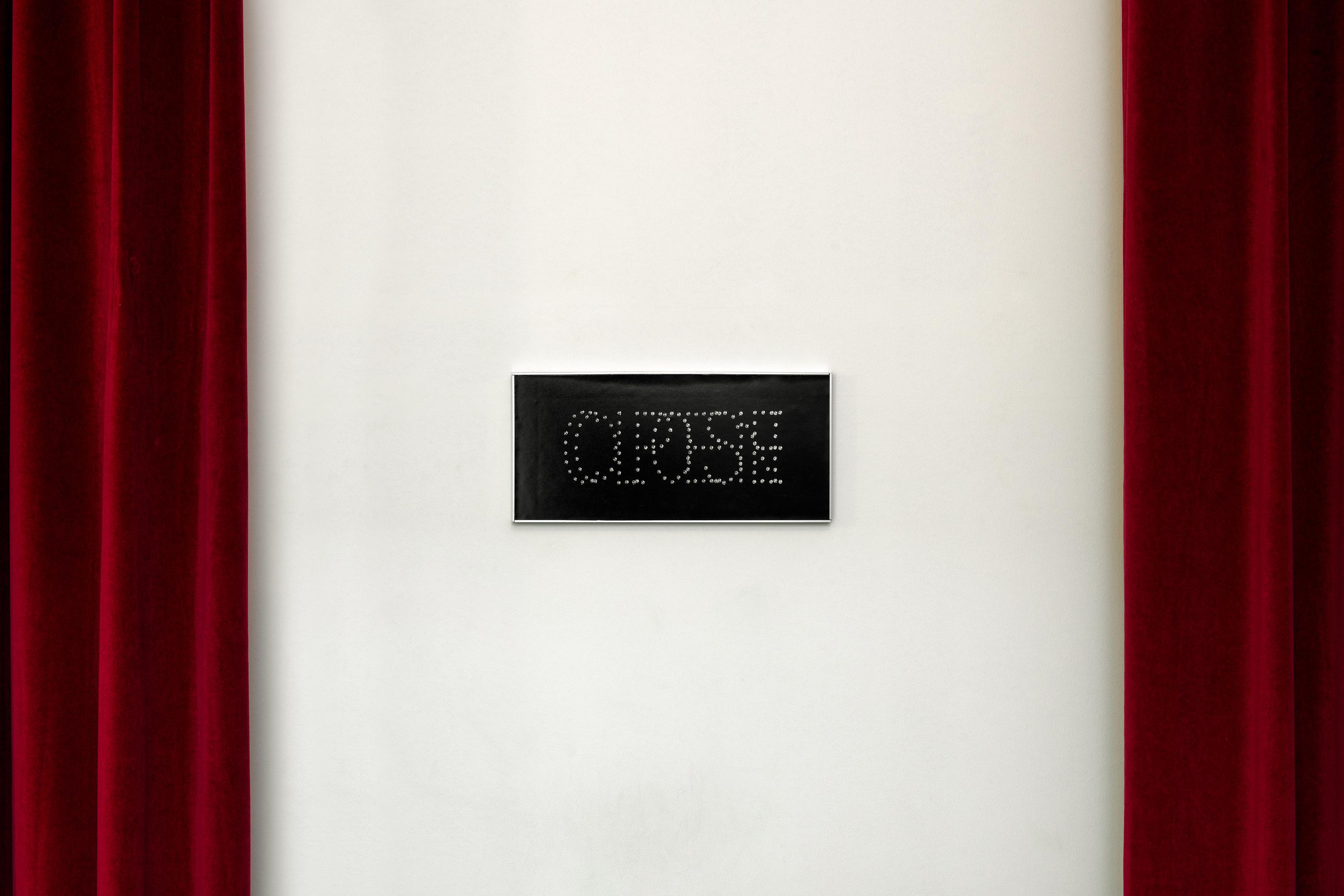
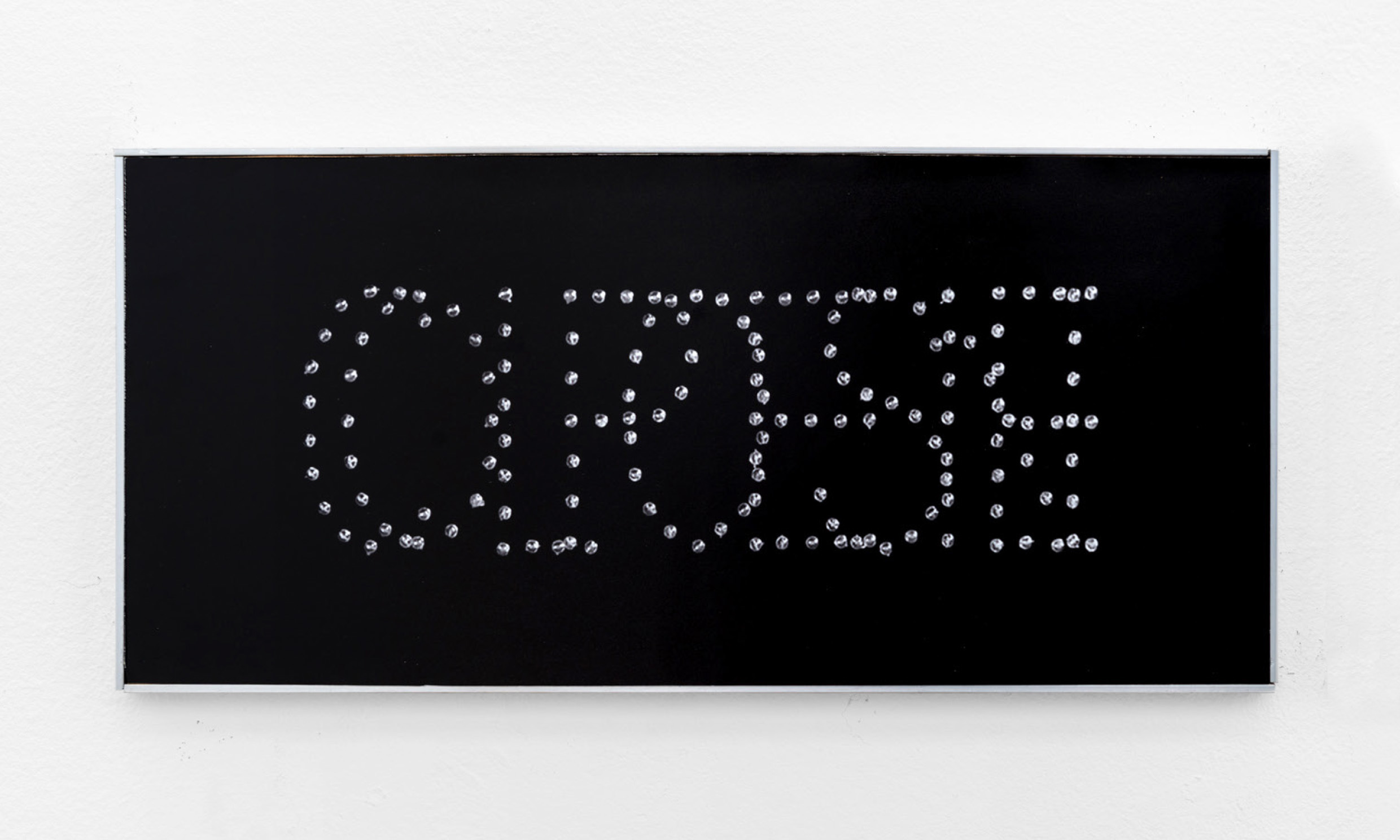
in another image of the series, an accompanying sign says “CLOSED”). Yet the play on the opening and closing of an eye-lid/a business encounters us itself in a corporate
fashion: The whole process of hospitality/contractuality in this case has become contractualized. Nevertheless, the photograph shows much of the paper itself, thus exposing the
openness, the photographic receptivity in its ultimate exposition to light (white comes to pass as over-exposure), transformed into the absenceof ink, the none-event of an
inkjet printer desisting from releasing color. This un-printed part of the page, however, is already determined by the inked portions at play. In this way, determinacy and indeterminacy,
contractuality and hospitality are seemingly inextricably intertwined, while the indeterminate part lends its hospitality to the concretion, the exploitation, the contractualization of
determining signifiers such as letters on a page. Needless to say that, as a work of art, Conditioned Air (2022) is also a commodity. It invites you to look at its open eye,
which is in turn looking back at you. It cites an advertisement, a promise to be served, to experience hospitality. Simultaneously, it advertises itself as a commodity, a piece
of art that can be bought and sold and function as an asset. The work is itself open– to be sold. In this way, the real social contract of the art market, which is capitalistic
in nature, breaks into the work, streamlining the tremors of hospitality towards the dissimulated and nevertheless undeniable reality of the art work: the work is also subject to a contract,
it is a commodity, an object of value.
The text you are looking at is no exception to this logic: The indeterminate hospitality of the page (most materially in its unprinted areas, such as the blank spaces between or within the
letters) must be dissimulated (ignored, abstracted from, forgotten … ) so as to enable the words to take shape. More so, the indeterminate hospitality (such as the blank spaces noted above)
of the page must be dissimulated so as to point out that this hospitality is there in the first place. For without such dissimulation, the inevitable disappearance of the page in favor
of the letter could not become the subject of a sentence – the page would just be blank instead. And not unlike Altenhofen’s Conditioned Air (2022), my own text enacts hospitality,
shares a thought, invites you in, while existing within the overarching and undeniable necessities of a capitalistic economy. I have to pay rent this month and next month and the month after,
while also exchanging different currencies into one another – social, cultural, financial, emotional etc. The commission for this text was a welcome opportunity and I am grateful for it. However,
this text is not an example of genuine hospitality – it must end rather sooner than later so as not to sell my labor crazy under value as I (have to) do much too often.
However, can a text that functions within the constrains of a financial economy at all embody or point towards genuine hospitality as this text has claimed earlier? Or will it inevitably
remain chained to itsmaterial underpinnings, determined by a weighed quantum of time and effort and originality (can’t spill all the creative ideas for an art opening, can I?) …. ? And if so in
which way exactly and where is it happening in this text? In any case, I live inside that problem. And I invite you to live here with me.
I received 350 € for this text.
Conditioned Air, 2022
Inkjet Print, artist frame
41 x 19 cm
Sky, 2022
Inkjet Print, artist frame
41 x 19 cm
Trouble! was a cabaret-style performance evening and exhibition with a curiosity for the social contract. With performances by Costanza Candeloro with Sophie Vitelli, Luce deLire, Johanna Kotlaris, Inger Wold Lund, Matilda Tjäder and Margaux Schwarz. Objects courtesy of Aisha Altenhofen, Sophie Fitze, Nelson Beer and Costanza Candeloro.
Organised by Nelson Beer
Documentation by Julian Blum